Blog · September 2, 2026 · 9 min read
8 Construction Estimating Mistakes (With the Real Math)
By the Amberdesk team
Most articles about construction estimating mistakes tell you the same thing: watch your labor, check your takeoffs, don't guess.
Fine advice. Zero numbers.
This post shows you the 8 construction estimating mistakes that quietly eat small-contractor profit — and what each one actually costs, in dollars, on a real bid.
To get those dollars, we built a complete 200 sqft cedar deck estimate in Amberdesk: 31 line items, $11,609.97 total. Then we measured what every mistake would do to it. (It's a demo company's book — realistic fixture data, not a customer's — but every figure below is computed by the estimating engine, not invented.)
For example: skipping the waste factor on this one small deck under-prices the bid by $349.05. Bidding the decking at last year's price loses another $232 on a single line.
Let's start with that one, because it's the mistake you're probably making tonight.
1. Bidding from last year's material prices
The most expensive number in your estimate is the one you copied from your last estimate.
Material prices move constantly, and they don't announce it. Here's the price history on one resource — cedar 5/4x6 decking — over ten months:
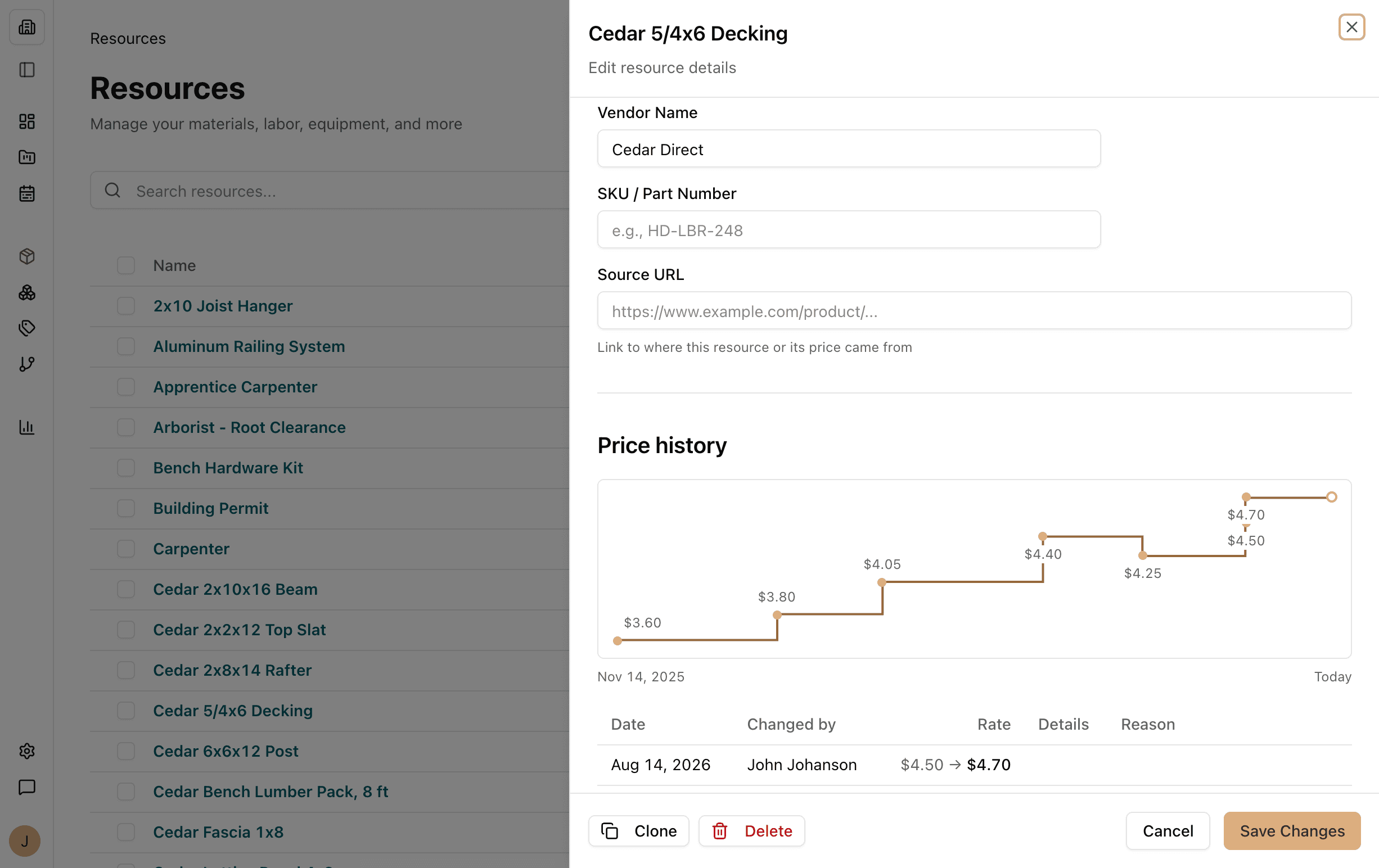
That's $3.60 to $4.70 per sqft — a 30.6% climb in ten months, in seven steps. Notice it dipped once, too ($4.40 down to $4.25). Prices aren't a straight line you can mentally adjust for.
Now the math. Our deck uses 192 sqft of that decking with 10% waste. Bid it at the November price and you're short 192 × 1.10 × $1.10 = $232 on one line item. A bigger deck, or three stale prices instead of one, and you've quietly donated a day's pay to the client.
How to avoid it:
- Keep one price list — a catalog — that every estimate reads from. Not a number typed into each spreadsheet.
- When a supplier quote comes in, update the catalog once. Every future estimate follows.
- Before you send any bid, re-check the 3–5 items that dominate its cost (here: decking, railing, carpenter rate).
2. Skipping the waste factor
Quantity × rate is not what materials cost. You cut boards short, break a bag, over-order to finish the job — that's waste, and it's real money.
On our 200 sqft deck, the estimating engine prices every material line with its own waste factor: 10% on decking and railing, 8% on concrete, 5% on gravel and screws. Here's what that adds up to on the whole job:
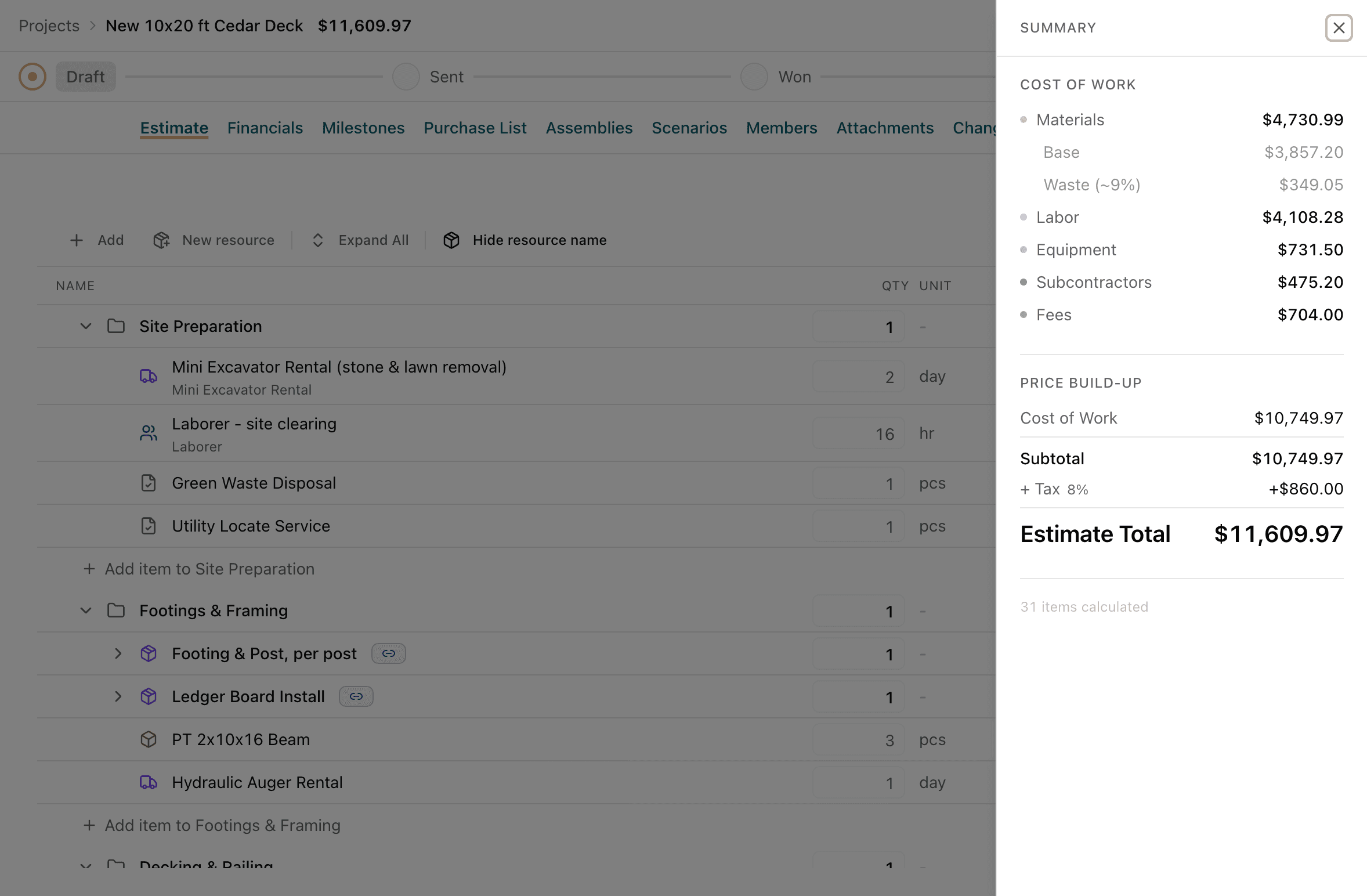
$349.05 of waste on one small deck. Skip it and your bid looks $349 sharper than the job you'll actually build — and the difference comes out of your pocket, not the client's.
How to avoid it:
- Set a default waste percentage per material in your price list — 10% on lumber, 5% on fasteners — so you never re-decide it per estimate.
- Let the line math be quantity × rate × (1 + waste). Never eyeball “a bit extra.”
- Review waste factors once a season against what you actually threw in the dumpster.
3. Confusing markup with margin
Markup and margin are different numbers, and mixing them up means you earn less than you think on every job.
Markup is what you add to cost. Margin is the share of the sale price you keep. A 50% markup is only a 33.33% margin:
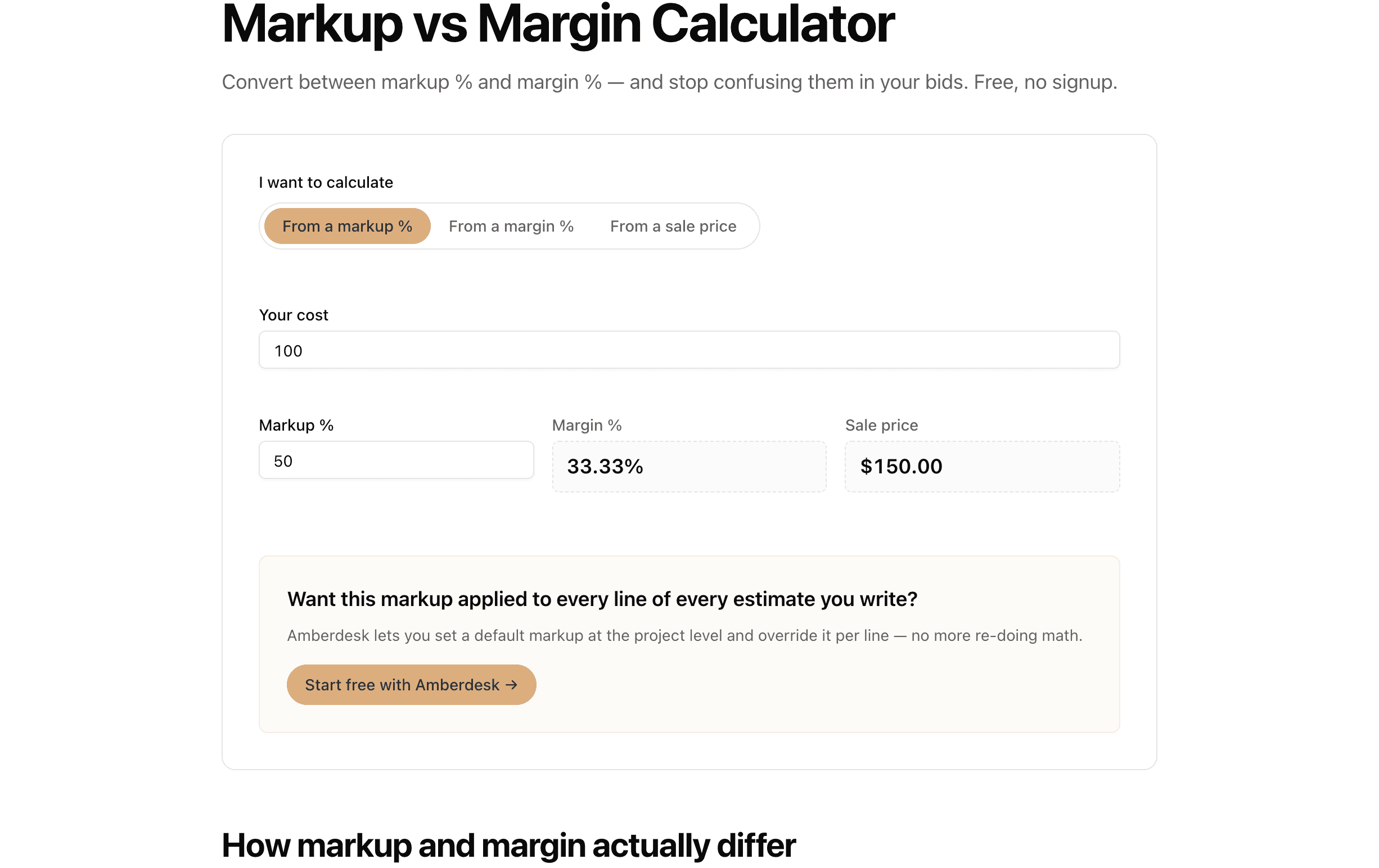
| You say | You get | The gap |
|---|---|---|
| "I mark up 15%" | 13.0% margin | −2.0 points |
| "I mark up 50%" | 33.3% margin | −16.7 points |
| Our deck: 10.5% blended markup | 9.5% margin | −1.0 point |
On the deck estimate, the blended markup across all 31 lines is 10.5% — which is a 9.5% margin. If you needed 10.5% margin to cover overhead, you just underpriced the job without noticing.
How to avoid it:
- Decide which number your overhead math needs — it's almost always margin.
- Convert it to markup before you bid — our free markup vs margin calculator does it both ways.
- Set that markup as the project default and override per line where the market allows more.
4. Trusting spreadsheet formulas you can't see
A spreadsheet estimate fails silently. The cell shows a confident number; the formula behind it stopped covering rows 38–41 when you inserted the electrical section at 11pm.
On this deck, the four lines at the bottom of the estimate — the permit, the utility locate, waste disposal, and the electrician — are worth $1,179.20. That's what one lazy SUM range quietly drops. No error message. The total just looks done.
Estimating software closes that failure mode by making every number computed, visibly, on every keystroke:
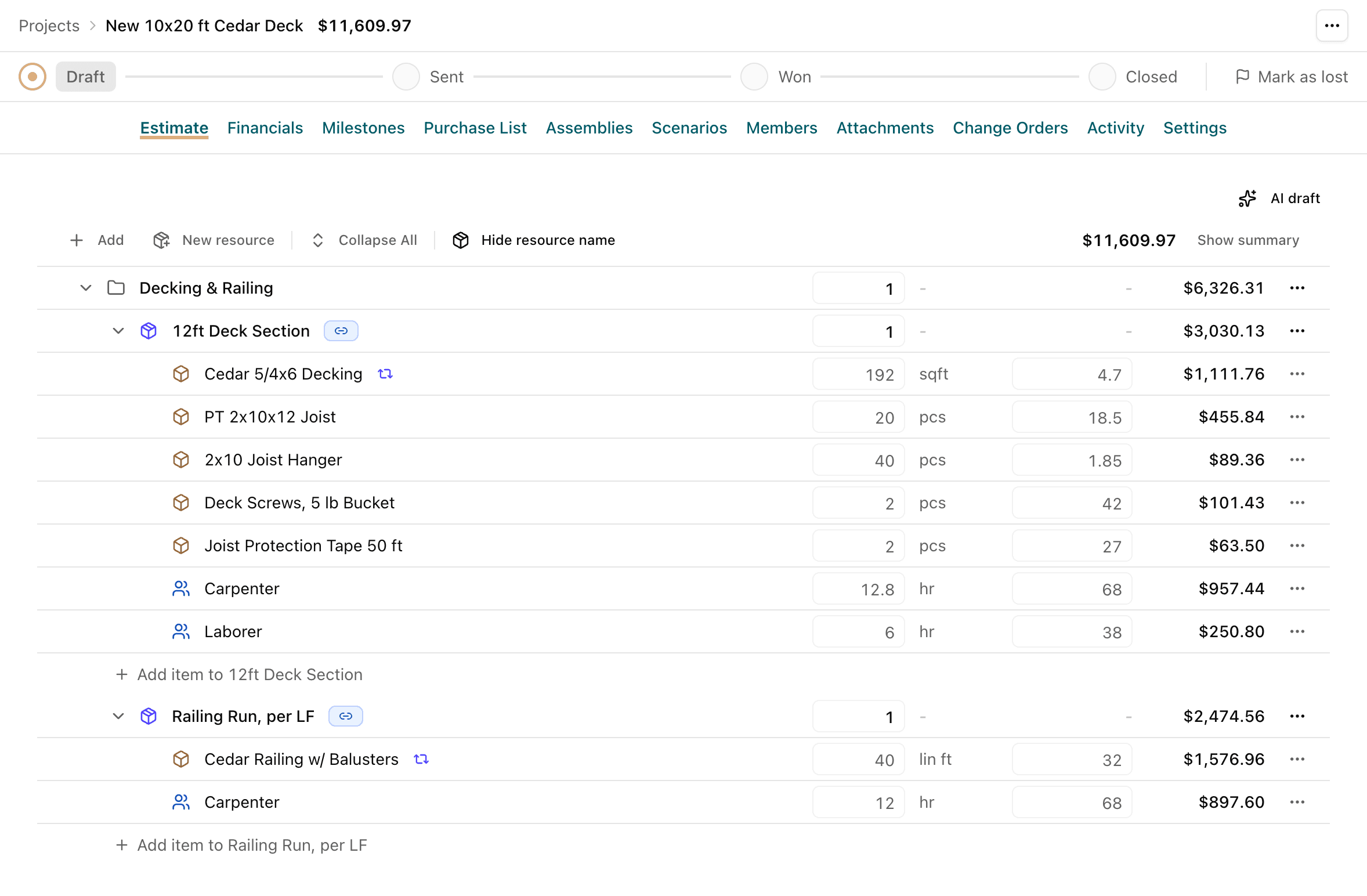
Look at the decking line: 192 × $4.70 is $902.40, but the line prices at $1,111.76 — because waste and markup are in the math, not in a formula you have to remember to drag down.
How to avoid it:
- If you stay in a spreadsheet: never type over a formula, and re-select every SUM range after inserting rows. Every time.
- Better: use a tool where lines, groups, and totals roll up automatically and can't drift out of sync.
- Either way, gut-check the per-sqft total ($58/sqft here) against your history before sending.
5. Leaving out entire cost categories
Materials and labor are the estimate you remember. Equipment, subcontractors, and fees are the estimate you forget.
Here's the same deck job broken down by cost type — all five, from one catalog:
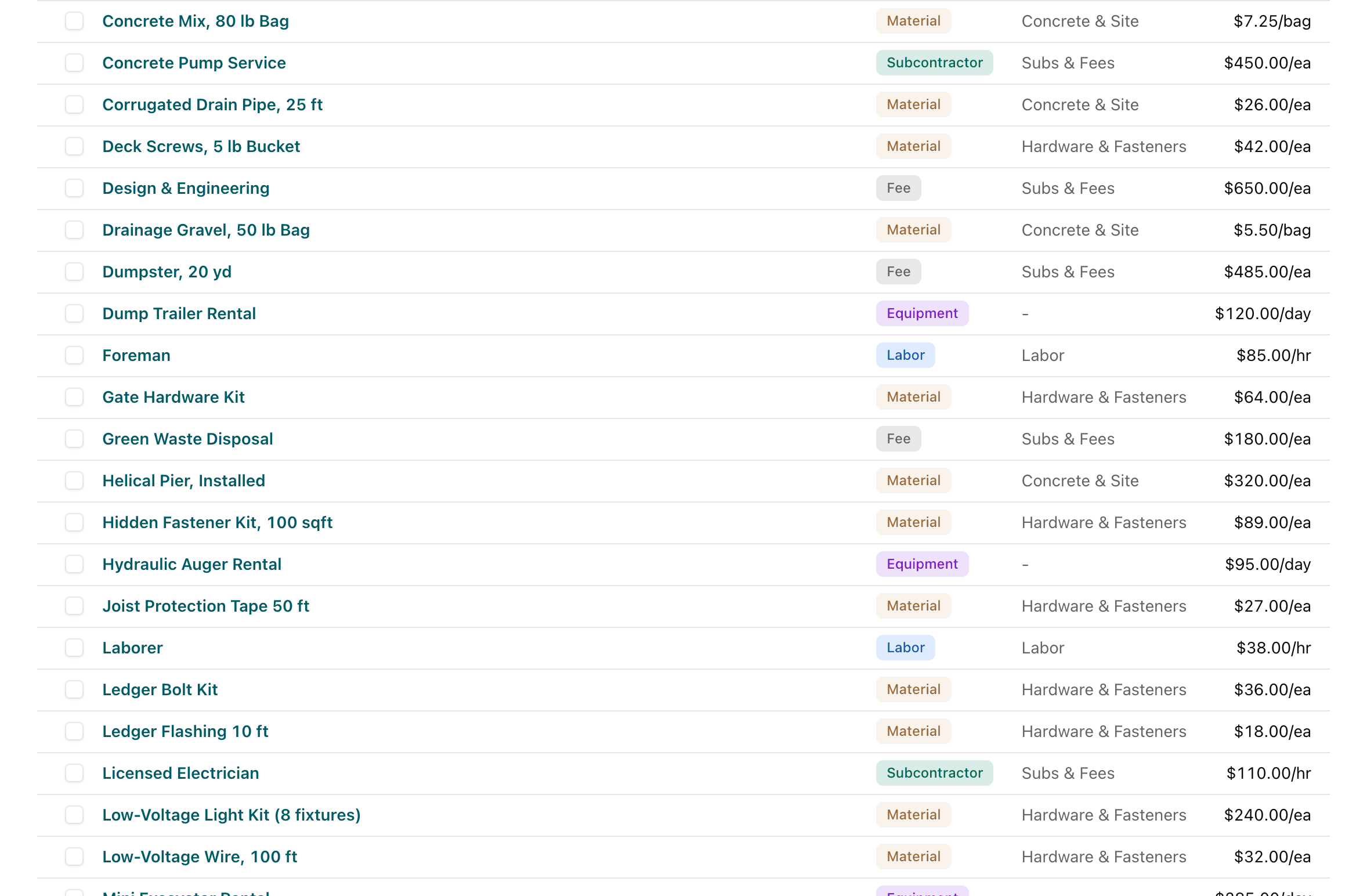
On our deck those "forgettable" categories are real lines: excavator rental $627, auger rental $104.50, a licensed electrician at $110/hr for the lighting rough-in ($475.20), permit $420, utility locate $95, green-waste disposal $189. Together: $1,910.70 — 17.8% of the subtotal.
And that's on a job where materials dominate. ConstructConnect notes most project budgets average 60 percent labor — the point is the same either way: whole categories, not line items, are where estimates go missing.
How to avoid it:
- Keep all five cost types in your catalog: materials, labor, equipment, subs, fees.
- Estimate in groups (Site Prep, Footings, Decking, Permits) so an empty group is visible.
- Steal our four permanent lines: permit, utility locate, disposal, equipment rental. Price them even when they're $0 — a zeroed line proves you asked the question.
6. Sending one number instead of options
One number invites one answer: "that's too much." Two numbers invite a different question: "which one do we want?"
The trap is that pricing a second option by hand means an evening of rework — so nobody does it. With alternates set up in your catalog, it's a substitution. Here's the same deck priced in cedar and composite, side by side:
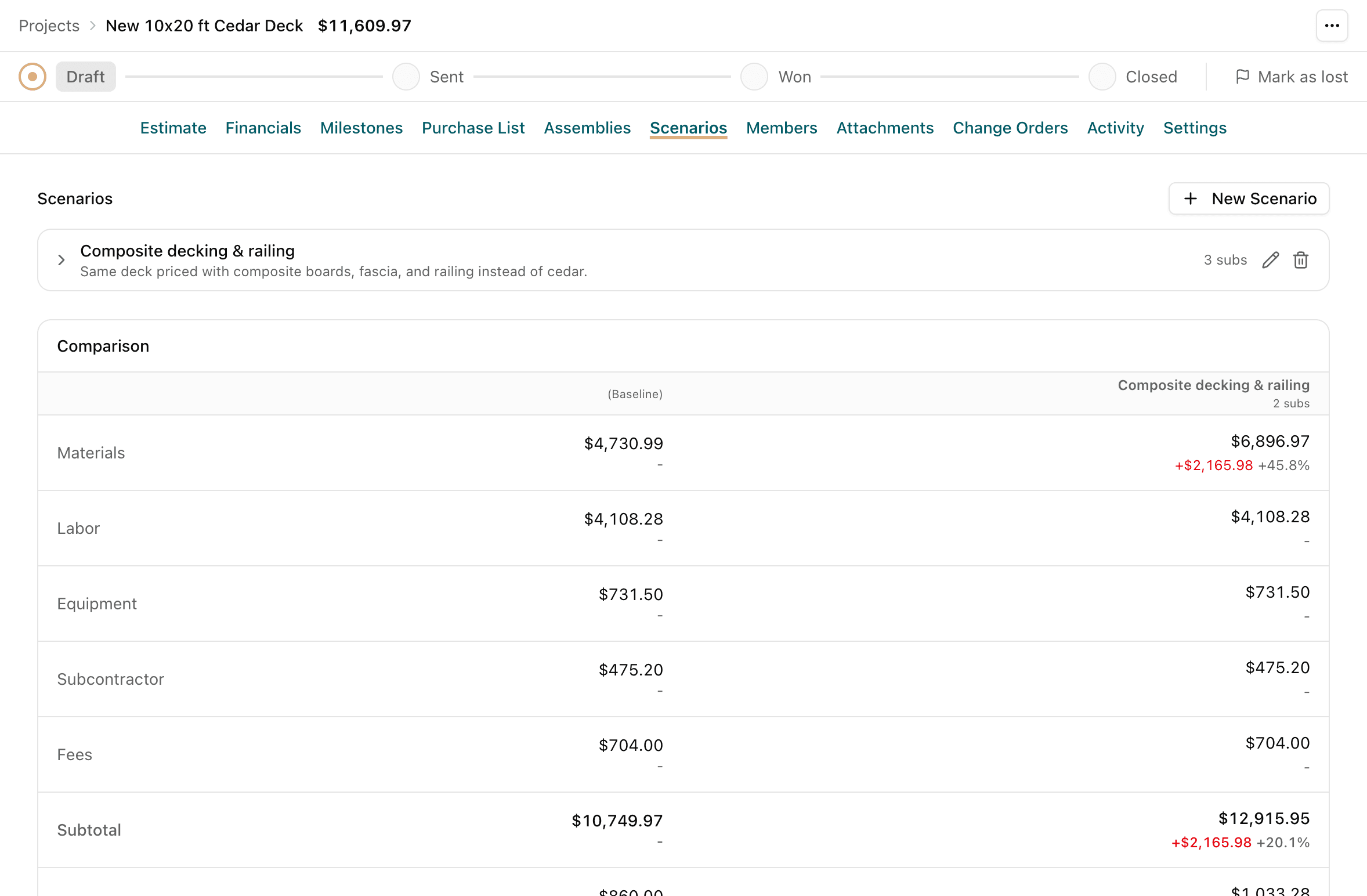
Composite raises materials 45.8% (+$2,165.98) while labor and equipment stay flat — so the total moves 20.1%, from $11,609.97 to $13,949.23 with tax. That's a conversation you can have with a client, with real numbers, instead of a guess on the phone.
How to avoid it:
- Group your interchangeable materials (cedar / PT / composite decking) as alternates.
- Price the estimate once, then generate the option as a substitution — not a second estimate.
- Put both options on the proposal and let the client pick their budget.
7. Handing the client your internal cost sheet
Your estimate and your proposal are different documents. One holds your costs, waste factors, and markup. The other is what the client reads over coffee — and forwards to their brother-in-law.
Export the spreadsheet you estimated in, and your margin is now a discussion topic.
Here's what should leave the building instead:
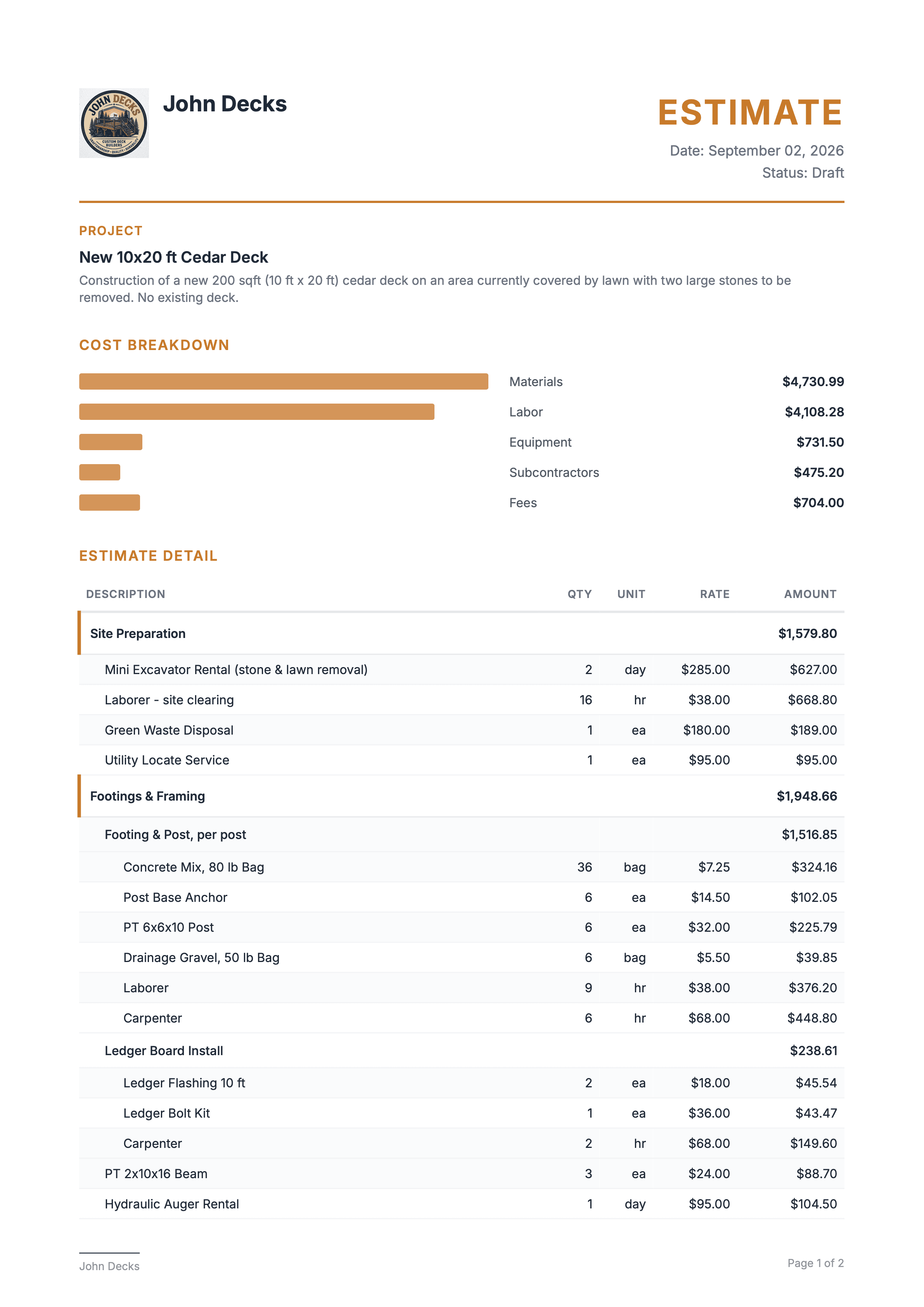
Every number on it is the price — line amounts, group subtotals, tax, total. Waste factors, your cost, and your markup per line exist only on your side.
How to avoid it:
- Never send the working file. Ever.
- Generate the client document from the estimate so it can't drift out of date.
- Choose the detail level deliberately: group totals for a simple job, line detail when the client demands it — but always prices, never costs.
8. Never comparing the bid to the actual cost
Your bid was a hypothesis. The job is the experiment. Skip the comparison and you'll make the same estimating mistake for years, precisely and confidently.
Here's the job-costing view of a finished deck rebuild — bid $12,706.11, plus an approved change order of $1,339.34:
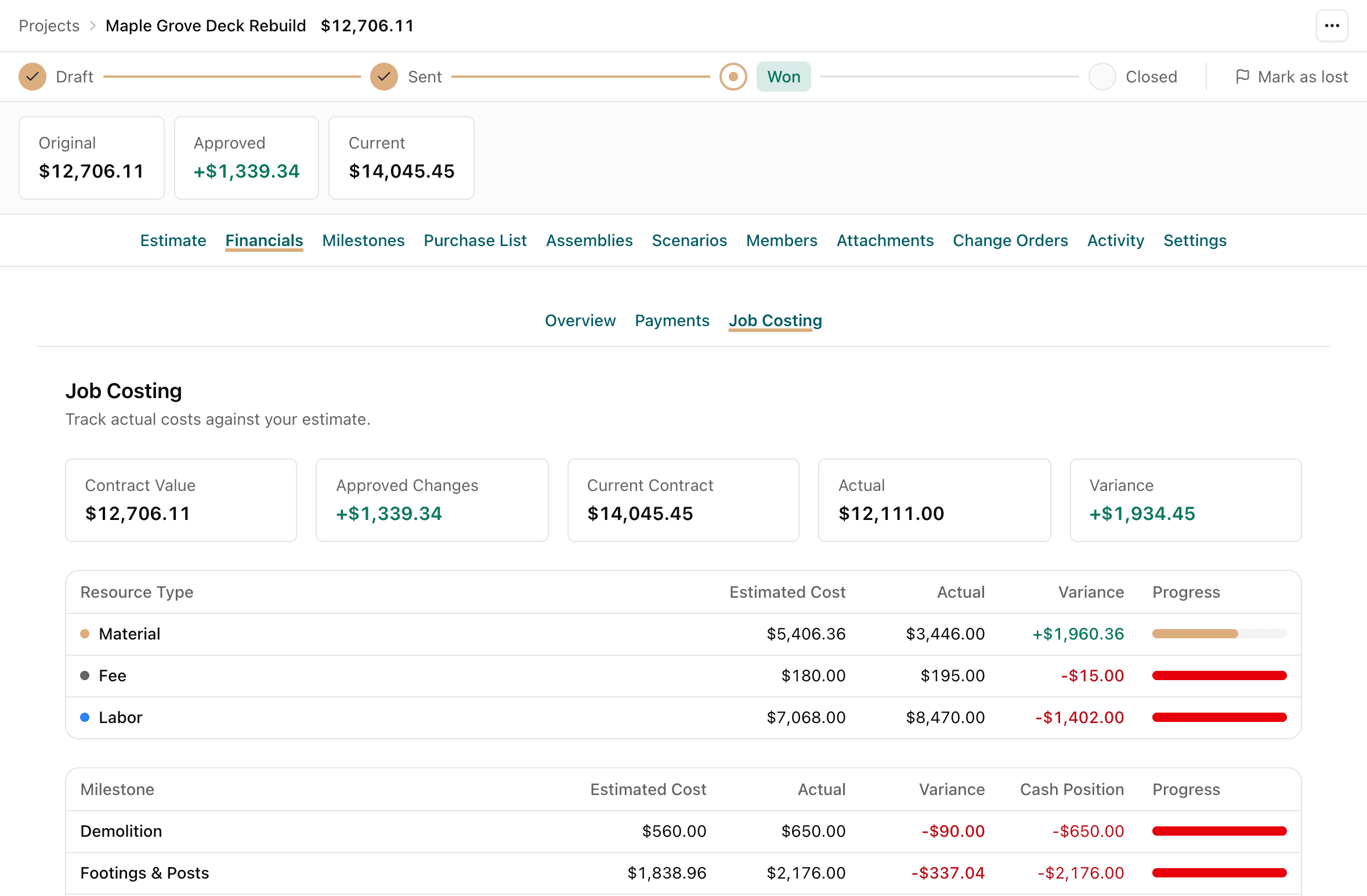
The job made money — variance +$1,934.45. But look inside: materials came in $1,960.36 under, while labor ran $1,402 over ($7,068 estimated, $8,470 actual). The materials cushion hid a labor-estimating problem. Next job might not have the cushion.
How to avoid it:
- Record actuals against the estimate by cost type, not just one lump sum.
- After every job, answer one question: which category was off by more than 10%, and why?
- Feed the answer back into your catalog rates — that's how estimate #50 gets sharper than estimate #5.
Which mistake is costing you the most?
Don't try to fix all eight this week.
Start with #1 and #2 — stale prices and missing waste. They're the fastest to fix (one price list, one waste default) and on our small demo deck alone they were worth $581 of silent underbidding. Mistake #8 is the one to build a habit around, because it compounds: every compared job makes the next bid better.
The one-hour version of all of this: put your real prices — all five cost types, with waste and markup defaults — into one catalog, and let every estimate read from it. That's exactly what Amberdesk does, and the 30-day trial needs no credit card.
Sources
- ConstructConnect, "8 Common Construction Estimating Mistakes" — constructconnect.com (the ~60% average labor share figure).
- All product figures: a 200 sqft cedar deck estimate and a finished deck-rebuild job in an Amberdesk demo organization, computed September 2, 2026. Realistic fixture data, not customer data.